Pilots: flight types and billing
What to choose when declaring a flight, and who pays for what once the flight is validated and sent to the ERP.
Flight types
| Type | On board | Conditions |
|---|---|---|
| Instruction | Student + instructor | Two-seater; the instructor is the second pilot |
| Solo | The pilot alone | Rated pilot (SPL, or authorised student) |
| Trial flight (VI) | VI pilot + passenger | Two-seater, VI-rated pilot, trial-flight voucher required |
| Shared | Two pilots | Two-seater, two rated pilots sharing the flight |
| Passenger | Pilot + passenger | Two-seater, passenger-rated pilot |
| First solo | The student alone | The instructor who sends them solo stays on the ground |
| Supervised | The student alone | Solo flight supervised by an instructor on the ground |
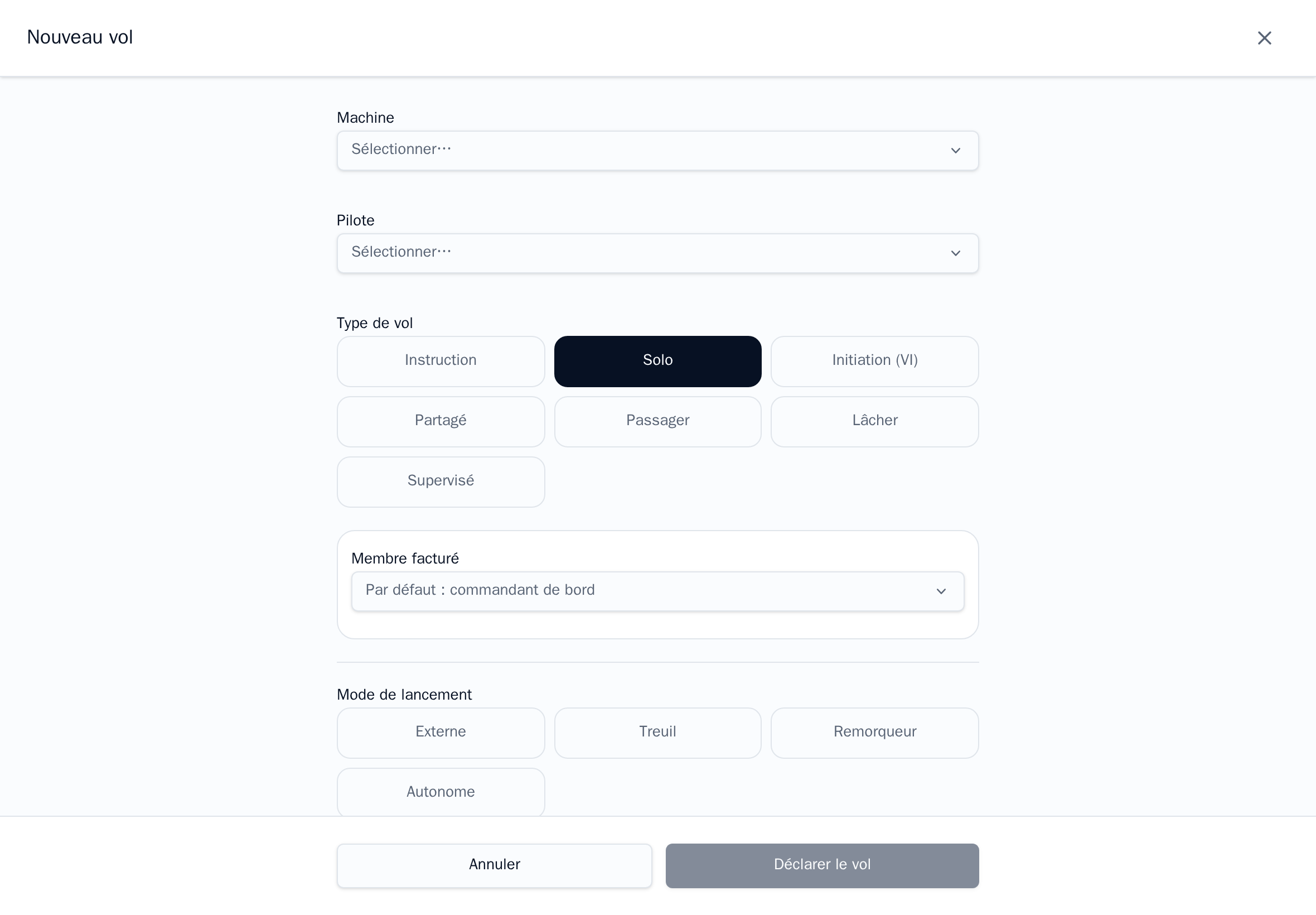
On a single-seater, only types without a passenger are offered. A TMG, a plane or a self-launching glider launched "Autonomous" also asks for the engine meter (see Managing flights).
Launch
| Method | Launch types (from the club's pricing) |
|---|---|
| Winch | Winch launch, cable break… |
| Tow plane | Tow, retrieval tow, ferry, training tow… |
| Autonomous | Plane flight, test, warm-up… (TMG, plane, self-launching glider) |
| External | Launched outside the club (no launch machine) |
The launch type is picked from a list that comes from the ERP's pricing; each method's first one is preselected (winch launch, tow, plane flight). It sets the price applied to the launch.
What is billed
Each validated flight produces a charge on the pilot's account (visible in the member portal), one line per priced item:
- Airframe: the glider's flight time, at the machine's rate;
- Engine: a TMG's or plane's engine time (in 1/100 h, computed from the meter);
- Launch: the tow (tow plane engine time, at the launch type's rate) or the winch launch (flat fee);
- Hour packs: hours covered by a purchased pack are billed at the pack price, then deducted from it.
Prices depend on the machine and the flight date (pricing versions).
Who pays?
| Flight type | By default | Other options |
|---|---|---|
| Solo, First solo, Supervised | The pilot | Solo: Billed member = a club account (comment required) or another member |
| Instruction | The student | Shared billing: 50 % student, 50 % instructor · Billed member = the instructor (or someone else): 100 % to them |
| Shared | 50 % each pilot | Billed member = one of them: 100 % to them |
| Passenger | The pilot | Billed member = the passenger (if a member) or a club account |
| Trial flight (VI) | The voucher (club's VI account) | Billed member = a member: billed like a normal flight |
The Billed member field is in the form's Billing section (collapsed by default); left empty, the default rule applies.
Club accounts
Some flights aren't paid by a pilot but charged to the club. The Billed member is then one of the configured club accounts:
| Account | For |
|---|---|
| Club flights | Flights for the club (ferries, demonstrations…) |
| Training flights | Training paid for by the club |
| Test flights | A machine's test flights |
| Warm-up time | A plane's engine warm-up (entered from + Warm-up) |
For a solo or instruction flight billed to a club account, a comment in the remarks is required.
Training tow
To train a tow pilot, the club can use the Training tow launch type: part of the tow (for example 30 %) is billed to the tow pilot, the rest to the flight's usual payers. The glider's airframe isn't affected.
After validation
- The duty manager validates the flight: it goes to the ERP.
- The ERP computes the charge with the rules above and posts it to the pilot's account.
- The pilot finds the flight and its cost in the member portal (account and logbook).
If billing is wrong, the office corrects the flight in the ERP (payer, type, times) and recomputes the charge.